
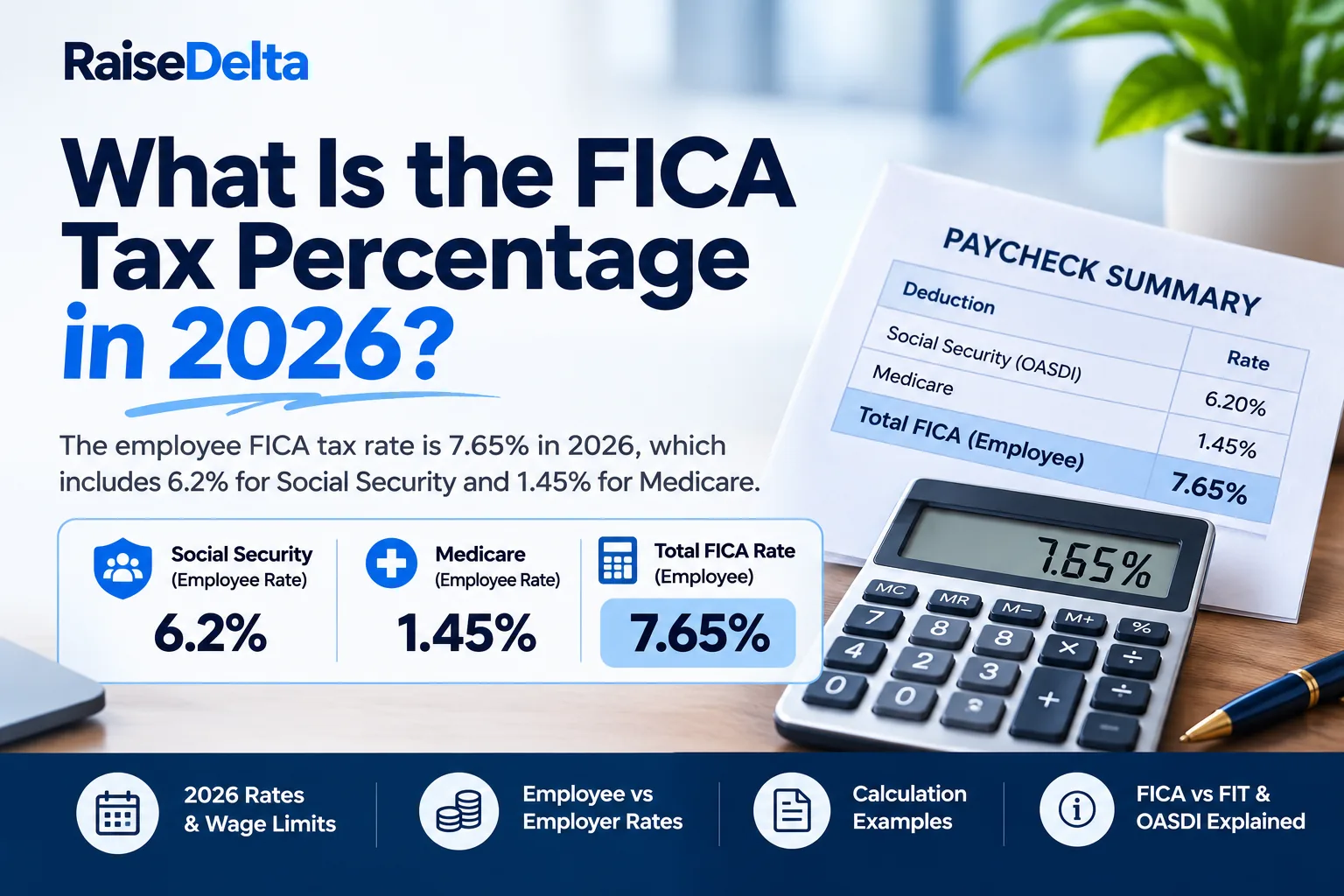
What is the FICA tax percentage in 2026? For most employees below the Social Security wage limit, the standard employee FICA rate is 7.65% of covered wages: 6.2% for Social Security plus 1.45% for Medicare. Employers generally pay a matching 7.65% of covered wages, so the standard combined employee-and-employer FICA rate is 15.3%.
The 7.65% figure is the quick answer, but it is not the whole story. Social Security tax has an annual wage cap, Medicare does not, and higher earners can also be subject to Additional Medicare Tax withholding. This guide explains the 2026 rates, how FICA appears on a paycheck, how to calculate it, and why your actual deduction may not always equal exactly 7.65% of gross pay.
What Is the FICA Tax Percentage in 2026?
| 2026 FICA component | Employee rate | Employer rate | Combined rate |
|---|---|---|---|
| Social Security (OASDI) | 6.2% | 6.2% | 12.4% |
| Medicare | 1.45% | 1.45% | 2.9% |
| Standard FICA total | 7.65% | 7.65% | 15.3% |
For an employee whose wages are fully subject to both taxes and who has not reached the Social Security wage base, the basic employee-side calculation is:
Employee FICA = Social Security taxable wages × 6.2% + Medicare taxable wages × 1.45%
For many employees early in the year, this works out to 7.65% of FICA-taxable wages. However, the taxable wage figure can differ from gross pay depending on how certain pre-tax benefits are treated.
If your FICA-taxable wages are lower than gross pay because of a cafeteria-plan benefit, see Section 125 on W-2 for how qualifying pre-tax benefits can affect federal, Social Security, and Medicare wage boxes.
What Does FICA Stand For?
FICA stands for the Federal Insurance Contributions Act. FICA taxes fund two federal programs:
- Social Security: formally known as Old-Age, Survivors, and Disability Insurance, or OASDI.
- Medicare: the Hospital Insurance portion of Medicare.
These payroll taxes are separate from federal income tax withholding. If you see several federal deductions on your pay stub, FICA is the Social Security and Medicare portion rather than the federal income tax amount calculated from your Form W-4 information.
2026 Social Security Tax: 6.2% Up to $184,500
The employee Social Security tax rate is 6.2% in 2026, and employers generally pay another 6.2%. Unlike Medicare, Social Security tax applies only up to an annual wage base.
| 2026 Social Security item | Amount |
|---|---|
| Employee rate | 6.2% |
| Employer rate | 6.2% |
| Combined rate | 12.4% |
| Social Security wage base | $184,500 |
| Maximum employee Social Security tax | $11,439 |
The maximum employee Social Security withholding is calculated as:
$184,500 × 6.2% = $11,439
Once an employee reaches $184,500 in Social Security taxable wages with the same employer during 2026, that employer generally stops withholding the 6.2% Social Security portion for the rest of the calendar year. The annual limit resets in the next calendar year.
For a deeper explanation of that deduction, wage cap, and excess-withholding rules, see OASDI Withholding.
2026 Medicare Tax: 1.45% With No Wage Cap
The standard employee Medicare tax rate is 1.45%, and employers generally contribute another 1.45%. Medicare tax has no annual wage-base limit, so covered wages can remain subject to the regular 1.45% Medicare tax even after Social Security withholding has stopped.
Additional Medicare Tax for higher earners
Employers must also withhold an additional 0.9% Medicare tax from wages they pay to an employee above $200,000 in a calendar year. The employer does not match this extra 0.9%.
The $200,000 payroll-withholding threshold is not the same as the final Additional Medicare Tax threshold used on an individual tax return, which can depend on filing status. This article focuses on what an employee may see withheld from a paycheck.
How to Calculate FICA Tax
For wages below the Social Security cap and before Additional Medicare withholding applies, the quick calculation is often:
FICA tax = FICA-taxable wages × 7.65%
Example 1: $50,000 annual wages
- Social Security: $50,000 × 6.2% = $3,100
- Medicare: $50,000 × 1.45% = $725
- Total employee FICA: $3,825
Example 2: $100,000 annual wages
- Social Security: $100,000 × 6.2% = $6,200
- Medicare: $100,000 × 1.45% = $1,450
- Total employee FICA: $7,650
Example 3: $220,000 annual wages in 2026
Assuming all wages are covered and paid by one employer:
- Social Security: capped at $184,500 × 6.2% = $11,439
- Regular Medicare: $220,000 × 1.45% = $3,190
- Additional Medicare withholding: $20,000 × 0.9% = $180
- Total employee Social Security and Medicare withholding in this example: $14,809
This is why a high earner’s effective FICA percentage for the full year may not equal exactly 7.65% of total gross wages.
What Is FICA on a Paycheck?
On a paycheck or pay stub, FICA may not appear as one single deduction. Payroll systems often separate it into two lines, such as:
- Social Security
- OASDI
- Fed OASDI/EE
- FICA Social Security
- Medicare
- Medicare EE
- FICA Medicare
If you add the standard employee Social Security and Medicare percentages together, the normal rate is 7.65% while your wages are still below the Social Security limit.
If you are trying to identify several unfamiliar deductions at once, see What Is a Pay Stub?
If you are reconciling year-end payroll with Form W-2 and see an unfamiliar employer-defined entry, our Box 14 W-2 codes guide explains common 2026 Box 14a labels and the separate Box 14b tipped-occupation field.
FICA Tax vs. Federal Income Tax
| Feature | FICA tax | Federal income tax withholding |
|---|---|---|
| Main purpose | Funds Social Security and Medicare | Prepayment of federal income tax |
| Standard employee rate | 7.65% before wage-limit effects | Varies |
| Based on Form W-4? | Generally no | Yes, along with wages and payroll tables |
| Social Security wage cap? | Yes, for the 6.2% Social Security portion | No equivalent FICA-style cap |
| Employer match? | Generally yes for standard Social Security and Medicare | No |
If your pay stub has a line labeled FIT, Fed Withholding, or Federal Income Tax, that is separate from FICA. See What Is FIT on a Pay Stub? for a detailed explanation.
FICA vs. OASDI: What Is the Difference?
FICA is the broader payroll-tax system. OASDI is only the Social Security portion of FICA.
- OASDI / Social Security: 6.2% employee rate in 2026, subject to the $184,500 wage base.
- Medicare: 1.45% standard employee rate, with no wage-base cap.
- FICA: includes both Social Security and Medicare taxes.
Keeping this distinction clear is useful when reading a pay stub: an OASDI line does not represent the entire FICA deduction.
Why Is My FICA Deduction Not Exactly 7.65%?
Several common situations can make the deduction look different from a simple 7.65% of gross pay:
- You reached the Social Security wage base. The 6.2% Social Security tax generally stops after $184,500 of Social Security taxable wages with the same employer in 2026, while Medicare continues.
- Additional Medicare withholding started. An employer begins withholding an extra 0.9% Medicare tax on wages it pays above $200,000 during the calendar year.
- Your FICA-taxable wages differ from gross pay. Some pre-tax benefit arrangements can reduce wages subject to certain payroll taxes, while others may not.
- You are comparing one deduction instead of both. A pay stub may show Social Security and Medicare on separate lines.
- Payroll rounding is involved. Small differences can occur when percentages are calculated and rounded each pay period.
To understand the starting amount before deductions, see What Is Gross Pay?
Do Employers Pay FICA Too?
Yes. Employers generally pay a matching 6.2% Social Security tax and 1.45% Medicare tax on covered employee wages. That is another 7.65% on the employer side before considering wage-limit rules.
The employer match is not taken from the employee’s take-home pay. It is a separate employer payroll-tax cost. Employers also do not match the employee’s 0.9% Additional Medicare Tax.
Is Everyone Subject to FICA Tax?
Most employees in covered employment are subject to Social Security and Medicare taxes, but specific exceptions exist. Examples can include certain students working for the school they attend, some nonresident aliens under particular visa and tax-status rules, and certain types of government or religious employment.
These exceptions are narrow and fact-specific. An employee should not assume that FICA is optional simply because they would prefer not to have the tax withheld.
How Does FICA Work for Self-Employed People?
Self-employed people generally do not have an employer withholding FICA from a paycheck. Instead, Social Security and Medicare taxes are generally paid through self-employment tax.
The combined self-employment tax rate is generally 15.3%: 12.4% for Social Security and 2.9% for Medicare, subject to the applicable Social Security wage base and other Schedule SE rules. The calculation is not simply 15.3% of gross business revenue, so employees should not use the employee FICA examples above to estimate self-employment tax.
How Much FICA Comes Out of a Paycheck?
For a typical employee below the Social Security wage limit, you can estimate the standard FICA deduction by multiplying FICA-taxable wages by 7.65%.
For example, if a biweekly paycheck has $3,000 of wages subject to both Social Security and Medicare:
- Social Security: $3,000 × 6.2% = $186.00
- Medicare: $3,000 × 1.45% = $43.50
- Total standard employee FICA: $229.50
For a broader estimate that includes federal withholding and other paycheck effects, use RaiseDelta’s Paycheck Calculator with Taxes.
2026 FICA Tax FAQs
Is FICA always 7.65%?
No. The standard employee rate is 7.65% while wages are subject to both the 6.2% Social Security tax and 1.45% Medicare tax. Once Social Security taxable wages reach the annual wage base, the 6.2% portion generally stops for that employer. Higher earners can also have 0.9% Additional Medicare Tax withheld on wages above $200,000.
What is the FICA tax percentage for employees in 2026?
The standard employee FICA percentage is 7.65%: 6.2% for Social Security plus 1.45% for Medicare, subject to the Social Security wage-base and Additional Medicare rules.
What is the employer FICA percentage?
Employers generally pay 7.65% as well: 6.2% for Social Security and 1.45% for Medicare. The employer does not match Additional Medicare Tax.
Is Medicare included in FICA?
Yes. FICA includes both Social Security and Medicare payroll taxes.
Is FICA the same as Social Security?
No. Social Security is one component of FICA. Medicare is the other standard component.
What is the maximum employee Social Security tax in 2026?
The maximum employee Social Security tax is $11,439, based on the 6.2% rate applied to the $184,500 Social Security wage base.
Does FICA come out of every paycheck?
For most employees in covered employment, Social Security and Medicare taxes are withheld from each paycheck. Social Security withholding can stop later in the year for employees who reach the annual wage base.
Official Sources
- IRS Publication 15 (2026), Employer’s Tax Guide
- IRS Topic No. 751 — Social Security and Medicare Withholding Rates
- Social Security Administration — Contribution and Benefit Base
RaiseDelta provides educational information and calculation tools, not individualized tax, payroll, or legal advice. Tax treatment can vary based on your wages, benefits, filing status, and employment situation.