
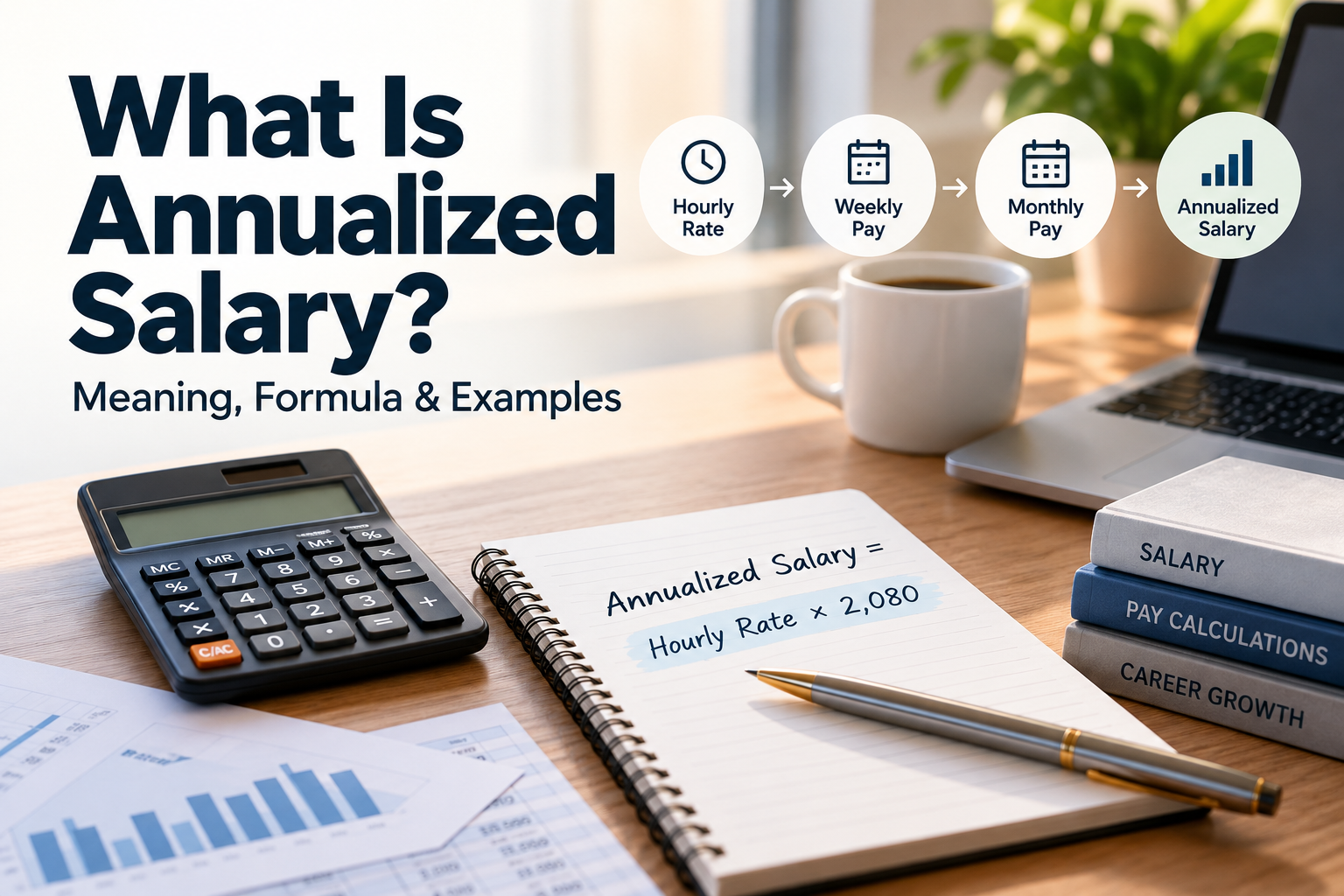
Annualized salary is the amount of pay a worker would earn over a full year if their current pay rate and work schedule continued for that year. It is a way to express hourly, weekly, biweekly, monthly, part-time or partial-year pay as a yearly figure so different compensation arrangements can be compared on the same basis.
For a full-time worker earning $25 per hour and working 40 hours per week, the annualized salary is $52,000: $25 × 40 × 52. But annualized salary is not always the same as the amount actually earned in a calendar year, and it is not the same thing as total compensation.
Annualized salary meaning
Annualized salary converts a current rate of pay into a yearly equivalent. The calculation assumes that the same pay rate and schedule continue for the period being annualized.
Quick definition: Annualized salary is a yearly pay equivalent based on a current pay rate and expected work schedule. It is a projection or standardized comparison figure—not automatically a guarantee of what a person will actually earn during the year.
This distinction matters for part-time, seasonal, temporary and newly hired employees. Someone can have an annualized salary of $50,000 but earn less than $50,000 during the current calendar year if they work only part of that year.
How to calculate annualized salary
The formula depends on how you are currently paid.
| Current pay basis | Annualized salary formula |
|---|---|
| Hourly | Hourly rate × hours per week × 52 |
| Weekly | Weekly pay × 52 |
| Biweekly | Biweekly pay × 26 |
| Monthly | Monthly pay × 12 |
| Part-time hourly | Hourly rate × expected weekly hours × 52 |
| Variable schedule | Hourly rate × expected annual hours |
The commonly used 2,080-hour shortcut comes from 40 hours per week × 52 weeks. It is useful only when a 40-hour weekly schedule is the right assumption. A 20-, 30- or 35-hour schedule should use its own expected annual hours instead.
Annualized salary from hourly pay
For hourly workers, use:
Annualized salary = Hourly rate × Hours per week × 52
| Hourly rate | Hours/week | Annualized salary |
|---|---|---|
| $15 | 40 | $31,200 |
| $20 | 40 | $41,600 |
| $25 | 40 | $52,000 |
| $30 | 40 | $62,400 |
| $40 | 40 | $83,200 |
| $50 | 40 | $104,000 |
If you earn $25 an hour but work 30 hours per week instead of 40, your annualized pay is $25 × 30 × 52 = $39,000, not $52,000. Using 2,080 hours for every worker can overstate part-time pay.
Annualized salary from weekly, biweekly or monthly pay
| Pay frequency | Current pay | Calculation | Annualized salary |
|---|---|---|---|
| Weekly | $1,100 | $1,100 × 52 | $57,200 |
| Biweekly | $2,200 | $2,200 × 26 | $57,200 |
| Monthly | $4,500 | $4,500 × 12 | $54,000 |
| Monthly | $6,500 | $6,500 × 12 | $78,000 |
These calculations assume the listed pay amount continues at the same frequency for a full year.
Annualized salary for part-time workers
Part-time annualization should use the worker’s expected schedule rather than automatically assuming 40 hours per week.
Example: a part-time employee earns $18 per hour and normally works 25 hours per week.
- Weekly pay: $18 × 25 = $450
- Annualized salary: $450 × 52 = $23,400
If the employee later moves to 40 hours per week at the same $18 rate, the full-time annualized amount becomes $37,440. The hourly rate did not change; the annualized figure changed because the expected schedule changed.
Annualized salary vs actual annual earnings
This is one of the most important distinctions. Annualized salary is a yearly equivalent; actual annual earnings are what you really receive during the year.
Suppose a seasonal worker earns $22 per hour, works 30 hours per week and is employed for 26 weeks:
- Annualized at that weekly schedule: $22 × 30 × 52 = $34,320
- Actual pay for 26 weeks: $22 × 30 × 26 = $17,160
The $34,320 figure is useful for comparing pay rates on a common annual basis, but the worker does not earn $34,320 unless that schedule actually continues for 52 weeks.
Annualized salary for a partial-year salaried employee
The same idea applies to someone who starts a salaried job partway through the year. If a job pays $78,000 per year and the employee starts on October 1, the annual salary rate is still $78,000, but the amount actually earned during that calendar year will be only the portion attributable to the months worked.
For a simple three-month illustration, $78,000 ÷ 12 × 3 = $19,500 of gross salary for those three months. Actual payroll can differ based on exact start date, pay periods and employer payroll rules.
How to annualize variable hours
When weekly hours fluctuate, using one unusually busy or quiet week can produce a misleading annual estimate. A better approach is to use expected annual hours or a representative average weekly schedule.
Example: an employee averages 28 hours per week at $17 per hour:
$17 × 28 × 52 = $24,752 annualized salary
If the schedule is highly seasonal, calculate annual hours directly rather than multiplying a single week’s hours by 52. This gives a more realistic projection.
Annualized salary vs annual salary
| Term | What it usually means |
|---|---|
| Annual salary | A stated yearly base salary for a salaried position |
| Annualized salary | A yearly equivalent calculated from a current rate, schedule or partial-year amount |
For a full-time salaried employee who works the entire year, the two figures may be identical. The term “annualized” becomes especially useful when the underlying pay is hourly, part-time, temporary, variable or covers less than a full year.
Annualized salary vs annual income
Annualized salary usually focuses on employment pay expressed as a yearly rate. Annual income can be broader because it may include other sources such as bonuses, commissions, freelance income, investment income or other earnings, depending on the context.
For example, an employee may have a $65,000 annualized base salary plus a $5,000 annual bonus. Their base salary is $65,000, while employment income including that bonus would be $70,000 before considering any other income sources.
Annualized salary vs total compensation
Annualized salary and total compensation should not be treated as the same number. Annualized salary generally represents pay or base wages expressed on a yearly basis. Total compensation can include additional employer-provided value such as:
- Performance or signing bonuses
- Commissions
- Employer retirement contributions
- Health and other insurance contributions
- Equity or stock awards
- Other employer-paid benefits
When comparing job offers, check whether a quoted number refers to base salary, expected cash compensation or total compensation. Two offers with the same annualized salary can still have very different overall value.
Does annualized salary include overtime?
Not automatically. A simple annualized salary based on regular hourly pay may exclude overtime, bonuses, commissions and other variable earnings. If overtime is a regular part of expected pay, a more realistic annual earnings projection should account for it separately.
Annualizing a rate also does not change whether an employee is eligible for overtime or alter their legal employment classification. Those questions depend on applicable wage-and-hour rules and the actual employment arrangement.
Is annualized salary gross or net?
Annualized salary normally refers to gross pay before taxes and payroll deductions. Take-home pay will be lower after applicable taxes, insurance, retirement contributions and other deductions.
When annualized salary is useful
- Comparing hourly and salaried jobs: convert both to the same annual basis.
- Evaluating a raise: see how an hourly or monthly increase changes yearly pay.
- Budgeting: estimate expected gross employment income.
- Part-time planning: understand what a recurring schedule is worth over a year.
- Offer comparison: separate base salary from bonuses and benefits.
If you are evaluating a pay increase, the RaiseDelta Salary Increase Calculator converts annual, monthly, biweekly, weekly and hourly pay into a common annual basis and shows the impact of a raise.
Annualized salary examples at a glance
| Situation | Annualized amount |
|---|---|
| $20/hour, 40 hours/week | $41,600 |
| $25/hour, 40 hours/week | $52,000 |
| $25/hour, 30 hours/week | $39,000 |
| $1,100/week | $57,200 |
| $2,200 biweekly | $57,200 |
| $4,500/month | $54,000 |
| $18/hour, 25 hours/week | $23,400 |
| $17/hour, average 28 hours/week | $24,752 |
Frequently asked questions
What does annualized salary mean?
It means pay expressed as a yearly equivalent based on a current pay rate and expected schedule. It may be a projection rather than the amount actually earned during a partial year.
How do I calculate annualized salary from hourly pay?
Multiply the hourly rate by expected hours per week and then by 52. At $25 per hour and 40 hours per week, annualized salary is $25 × 40 × 52 = $52,000.
Why do people use 2,080 hours?
Because 40 hours per week × 52 weeks equals 2,080 hours. It is a convenient full-time conversion assumption, but it should not be used for someone whose normal schedule is different.
Is annualized salary the same as yearly salary?
Sometimes. For a full-year salaried employee, they can be the same. “Annualized” is more often used when converting hourly, monthly, part-time, variable or partial-year pay into a yearly equivalent.
Does annualized salary include bonuses?
Usually not when the term refers to base salary. If a compensation figure includes bonuses, commissions or benefits, it should be labeled clearly as expected cash compensation or total compensation rather than assumed to be part of annualized base salary.
Can annualized salary be higher than what I actually earn?
Yes. A seasonal or partial-year employee can have a higher annualized figure than actual calendar-year earnings because annualization assumes the current rate or schedule continues for a full year.
Use annualized salary to compare pay clearly
Annualizing pay is most useful when it makes unlike pay structures comparable. Use the correct work schedule, keep projected annualized pay separate from actual earnings, and do not confuse base salary with total compensation.
For raise planning, use the Annual Raise Calculator to project recurring percentage increases, or see How to Calculate Salary Increase Percentage when you know your old and new pay but need the percentage change.
3 responses to “What Is an Annualized Salary? Meaning, Formula & Examples”
[…] These annual estimates assume 40 hours per week for 52 weeks, or 2,080 paid hours per year. If your hours vary, multiply the hourly raise by your expected annual hours instead. For more on converting hourly, part-time or partial-year pay into a yearly equivalent, see What Is an Annualized Salary?. […]
[…] For a detailed explanation of yearly-equivalent pay, see What Is an Annualized Salary?. […]
[…] explanation of converting hourly, part-time or partial-year pay into a yearly equivalent, see What Is an Annualized Salary?. If you want to include bonuses, commissions or other yearly income sources, see What Is Annual […]